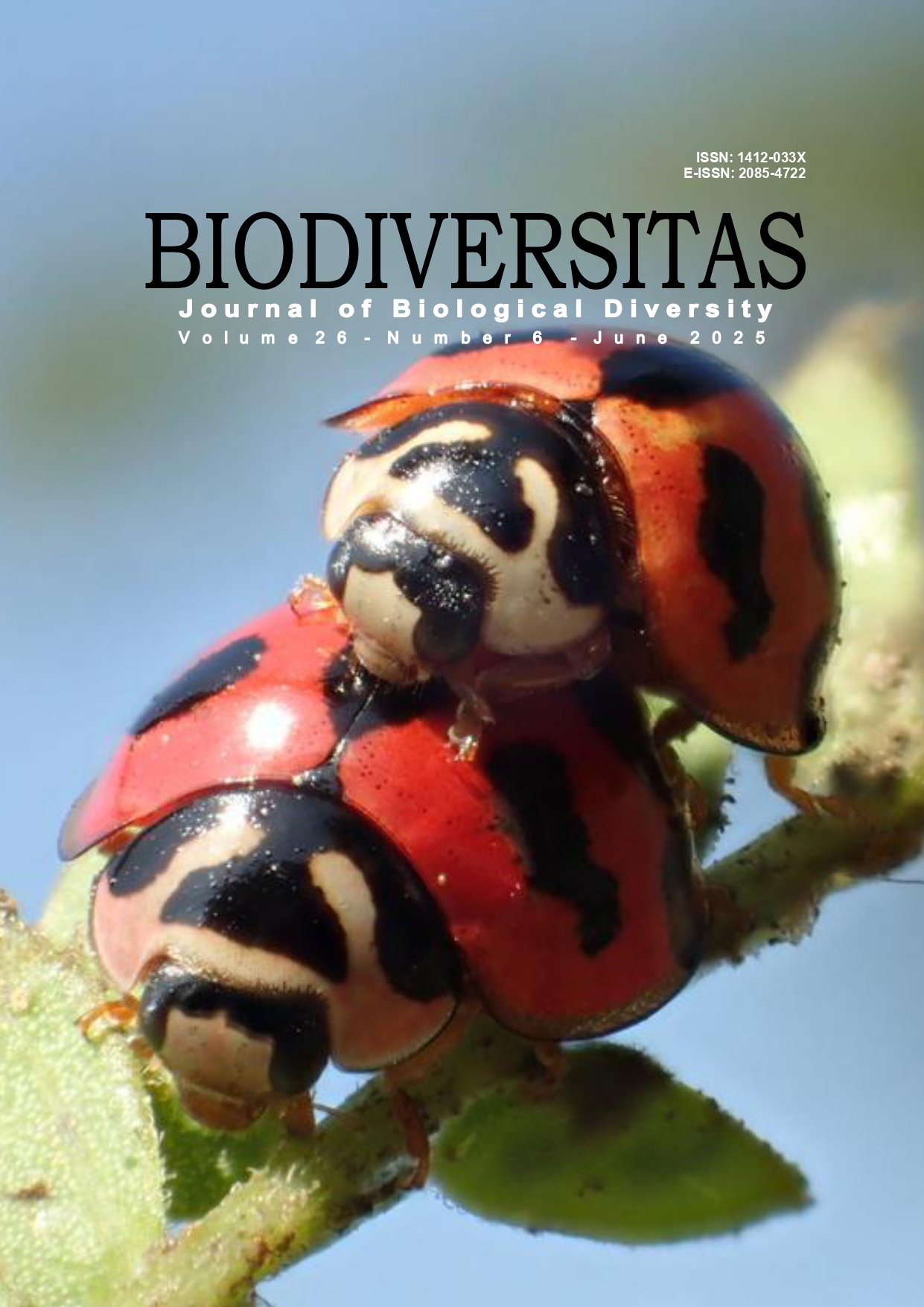
Application of Gaultheria essential oil attractant to increase abundance zigzag ladybird beetle (Cheilomenes sexmaculata) and other coccinellids
Article Sidebar
Abstract Views: 279
File Views: 39
Main Article Content
Abstract
Abstract. Efendi S, Dadang, Winasa IW, Nurmansyah A. 2025. Application of Gaultheria essential oil attractant to increase abundance zigzag ladybird beetle (Cheilomenes sexmaculata) and other coccinellids. Biodiversitas 26: 2674-2683. Gaultheria essential Oil (GeO) has the potential to be used as an attractant for Cheilomenes sexmaculata because of its high Methyl Salicylate (MeSA) content. The research aimed to evaluate the effectiveness of GeO attractant against C. sexmaculata and its effect on other coccinellids. The tested GeO attractant doses were 0.25 mL, 0.5 mL, 1 mL, and 2 mL/dispenser. The data was analyzed with the Kruskal-Wallis non-parametric median test, with a Mann-Whitney post-test corrected Holm test. The analysis uses the ggstatsplot package version 0.13.0 in R Studio software version 4.4.2. The causal relationship between attractants, abundance, coccinellid richness, and chili (Capsicum annuum) yield was analyzed using a Structural Equation Model (SEM). The results showed that GeO attractant affects the abundance of C. sexmaculata. The attractant GeO also accelerates the presence of C. sexmaculata in chili crops. In addition, GeO attractants also affect the abundance of other predatory coccinellids, namely Micraspis lineata, Harmonia decussata, Coelophora maculata, Coleophora inaequalis, Scymnus sp., Curinus coeruleus, Coccinella transversalis, and Cryptolaemus montrouzieri. The application of GeO attractants, abundance of C. Sexmaculata and Aphis gossypii are directly and significantly related to chili yield. GeO attractant can be a new component of Integrated Pest Management (IPM) to control A. gossypii in chili cultivation.
Article Details
Issue
Section

This work is licensed under a Creative Commons Attribution-NonCommercial-ShareAlike 4.0 International License.
References
Aartsma Y, Bianchi FJJA, van der Werf W, Poelman EH, Dicke M. 2017. Herbivore-induced plant volatiles and tritrophic interactions across spatial scales. New Phytol 216: 1054-1063. DOI: 10.1111/nph.14475.
Al-Shami S, Qureshi JA. 2022. Predation of florida red scale Chrysomphalus aonidum (L.) by the metallic blue ladybeetle Curinus coeruleus (Mulsant). Bull Entomol Res 8: 1-8. DOI: 10.1017/S0007485321000936.
Andrade FM, Sales L, Favaris AP, Bento JMS, Mithöfer A, Peñaflor MFGV. 2023. Identity matters: Multiple herbivory induces less attractive or repellent coffee plant volatile emission to different natural enemies. J Chem Ecol 49 (11-12): 696-709. DOI: 10.1007/s10886-023-01454-x.
Aprila M, Rover, Efendi MS. 2019. Diversitas coccinellidae predator pada ekosistem pertanaman cabai di tiga Kecamatan Kabupaten Kuantan Singingi. Jurnal Agronomi Tanaman Tropika 1 (2): 32-41. DOI: 10.36378/juatika.v1i1.35. [Indonesian]
Bolter CJ, Dicke M, Van Loon JJA, Visser JH, Posthumus MA. 1997. Attraction of colorado potato beetle to herbivore-Damaged plants during herbivory and after its termination. J Chem Ecol 23: 1003-1023. DOI: 10.1023/B:JOEC.0000006385.70652.5e.
Chen L, Wang W-S, Wang T, Meng X-F, Chen T-T, Huang X-X, Li Y-J, Hou B-K. 2019. Methyl salicylate glucosylation regulates plant defense signaling and systemic acquired resistance. Plant Physiol 180 (4): 2167-2181. DOI: 10.1104/pp.19.00091.
Collier T, Van Steenwyk R. 2020. A critical evaluation of augmentative biological control. Biol Control 31 (2): 245-256. DOI: 10.1016/j.biocontrol.2004.05.001.
Dong Y-J, Hwang S-Y. 2017. Cucumber plants baited with methyl salicylate accelerates Scymnus (Pullus) sodalis (Coleoptera: Coccinellidae) visiting to reduce cotton aphid (Hemiptera: Aphididae) infestation. J Econ Entomol 110 (5): 2092-2099. DOI: 10.1093/jee/tox240.
Dong Y-J, Hwang S-Y. 2024. Evaluation of the effectiveness of four herbivore-induced plant volatiles on attracting natural enemies. J Taiwan Agric Res 62: 173-183. DOI: 10.6156/jtar/2016.06502.07.
Edde PA. 2022. Arthropod pests of maize Zea mays (L.). In: Field Crop Arthropod Pests of Economic Importance. Academic Press, Cambridge, Massachusetts, USA. DOI: 10.1016/B978-0-12-818621-3.00008-2.
Efendi S, Yaherwandi, Nelly N. 2017. Analisis keanekaragaman coccinellidae predator dan kutu daun (Aphididae spp) pada ekosistem pertanaman cabai di Sumatera Barat. Jurnal Bibiet 1 (2): 32-46. DOI: 10.22216/jbbt.v1i2.1697. [Indonesian]
Gadino AN, Walton VM, Lee JC. 2012. Evaluation of methyl salicylate lures on populations of Typhlodromus pyri (Acari: Phytoseiidae) and other natural enemies in western Oregon vineyards. Biol Control 63 (1): 48-55. DOI: 10.1016/j.biocontrol.2012.06.006.
Gondor OK, Pál M, Janda T, Szalai G. 2022. The role of methyl salicylate in plant growth under stress conditions. J Plant Physiol 277: 153809. DOI: 10.1016/j.jplph.2022.153809.
Heimpel GE, Asplen MK. 2021. A “Goldilocks” hypothesis for dispersal of biological control agents. BioControl 56: 441-450. DOI: 10.1007/s10526-011-9381-7.
Hidayat P, Tambunan VB, Putirama KD. 2021. Tanggap fungsional predator Menochilus sexmaculatus (Fabricius) dan Micraspis lineata (Thunberg) (Coleoptera: Coccinellidae) terhadap kutukebul Bemisia tabaci (Gennadius) (Hemiptera: Aleyrodidae) dan kutudaun Myzus persicae (Sulzer) (Hemiptera: Aphididae). Jurnal Entomologi Indonesia 18 (3): 199-206. DOI: 10.5994/jei.18.3.199. [Indonesian]
Hithesh GR, Suroshe SS, Nebapure S, Keerthi MC. 2024. Behavioural response of C. sexmaculata to the volatiles from B. brassicae and cabbage. Allelopath J 61 (1): 63-76. DOI: 10.26651/allelo.j/2024-61-1-1470.
Ives AR, Cardinale BJ, Snyder WE. 2005. A synthesis of subdisciplines: Predator-prey interactions, and biodiversity and ecosystem functioning. Ecol Lett 8: 102-116. DOI: 10.1111/j.1461-0248.2004.00698.x.
Jagdish J, Bhaskar H, Khan H, Tegelli R, Ranjith AM. 2011. Response of Cheilomenes sexmaculata (Fabricius) to natural enemy and pest mediated conspecific semiochemicals. Res J Agric Sci 2 (3): 2-4.
Jonsson M, Kaartinen R, Straub CS. 2017. Relationships between natural enemy diversity and biological control. Curr Opin Insect Sci 20: 1-6. DOI: 10.1016/j.cois.2017.01.001.
Katano I, Doi H, Eriksson BK, Hillebrand H. 2015. A cross-system meta-analysis reveals coupled predation effects on prey biomass and diversity. Oikos 124 (11): 1427-1435. DOI: 10.1111/oik.02430.
Kelly JL, Hagler JR, Kaplan I. 2014. Semiochemical lures reduce emigration and enhance pest control services in open-field predator augmentation. Biol Control 71: 70-77. DOI: 10.1016/j.biocontrol.2014.01.010.
Krakos KN, Booth GM, Gardner JS, Neipp MG. 2011. Nectar for plant defense: The feeding of the non-native coccinellid beetle, Curinus coeruleus, on extra-floral nectaries of hawaiian native Hibiscus brackenridgei. Intl J Insect Sci 3: 11-21. DOI: 10.4137/ijis.s7162.
Kumar M, Sarma P, Dkhar MS, Kayang H, Raghuwanshi R, Dubey NK. 2018. Assessment of chemically characterised Gaultheria fragrantissima Wall. essential oil and its major component as safe plant based preservative for millets against fungal, aflatoxin contamination and lipid peroxidation during storage. J Food Sci Technol 55 (1): 111-119. DOI: 10.1007/s13197-017-2842-y.
Kumari H. 2024. Management of thrips and mites in chilli crop. Agric Food: E-Newsletter 6 (3): 210-213.
Maeda T, Kishimoto H, Wright LC, James DG. 2015. Mixture of synthetic herbivore-induced plant volatiles attracts more Stethorus punctum picipes (Casey) (Coleoptera: Coccinellidae) than a single volatile. J Insect Behav 28 (2): 126-137. DOI: 10.1007/s10905-015-9489-1.
Maes S, Grégoire J-C, De Clercq P. 2014. Prey range of the predatory ladybird Cryptolaemus montrouzieri. BioControl 59 (6): 729-738. DOI: 10.1007/s10526-014-9608-5.
Mallinger RE, Hogg DB, Gratton C. 2011. Methyl salicylate attracts natural enemies and reduces populations of soybean aphids (Hemiptera: Aphididae) in soybean agroecosystems. J Econ Entomol 104 (1): 115-124. DOI: 10.1603/EC10253.
Michel P, Olszewska MA. 2024. Phytochemistry and biological profile of Gaultheria procumbens L. and wintergreen essential oil: From traditional application to molecular mechanisms and therapeutic targets. Intl J Mol Sci 25 (1): 565. DOI: 10.3390/ijms25010565.
Mukhopadhyay M, Bantawa P, Mondal TK, Nandi SK. 2016. Biological and phylogenetic advancements of Gaultheria fragrantissima: Economically important oil bearing medicinal plant. Ind Crops Prod 81: 91-99. DOI: 10.1016/j.indcrop.2015.11.042.
Munawar A, Zhang Y, Zhong J, Ge Y, El-Ela ASA, Mao Z, Ntiri ES, Mao L-J, Zhu Z, Zhou W. 2022. Heat stress affects potato’s volatile emissions that mediate agronomically important trophic interactions. Plant Cell Environ 45 (10): 3036-3051. DOI: 10.1111/pce.14416.
Naranjo SE, Hagler JR, Byers JA. 2021. Methyl salicylate fails to enhance arthropod predator abundance or predator to pest ratios in cotton. Environ Entomol 50 (2): 293-305. DOI: 10.1093/ee/nvaa175.
Obrycki JJ, Harwood JD, Kring TJ, O’Neil RJ. 2019. Aphidophagy by Coccinellidae: Application of biological control in agroecosystems. Biol Control 51 (2): 244-254. DOI: 10.1016/j.biocontrol.2009.05.009.
Ojha PK, Poudel DK, Dangol S, Rokaya A, Timsina S, Satyal P, Setzer WN. 2022. Volatile constituent analysis of wintergreen essential oil and comparison with synthetic methyl salicylate for authentication. Plants 11 (8): 1090. DOI: 10.3390/plants11081090.
Omkar, Pervez A. 2016. Ladybird beetles. In: Omkar (eds). Ecofriendly Pest Management for Food Security. Academic Press, Cambridge, Massachusetts, USA. DOI: 10.1016/B978-0-12-803265-7.00009-9.
Pelosi P, Iovinella I, Zhu J, Wang G, Dani FR. 2018. Beyond chemoreception: Diverse tasks of soluble olfactory proteins in insects. Biol Rev Camb Philos Soc 93 (1): 184-200. DOI: 10.1111/brv.12339.
Rahmawasiah, Abadi AL, Mudjiono G, Rizali A. 2022. The effect of integrated pest management on Scirpophaga innotata population and natural enemies on rice fields in South Sulawesi, Indonesia. Biodiversitas 23 (9): 4510-4516. DOI: 10.13057/biodiv/d230917.
Rakshith HS, Suroshe SS, Chander SMNS, Kumari S. 2018. Behavioural response of Coccinella transversalis to the volatiles from Aphis craccivora and Cowpea. Indian J Entomol 80 (4): 1331. DOI: 10.5958/0974-8172.2018.00311.5.
Razo-Belman R, Ozuna C. 2023. Volatile organic compounds: A review of their current applications as pest biocontrol and disease management. Horticulturae 9: 441. DOI: 10.3390/horticulturae9040441.
Riahi C, González-Rodríguez J, Alonso-Valiente M, Urbaneja A, Pérez-Hedo M. 2022. Eliciting plant defenses through herbivore-induced plant volatiles’ exposure in sweet peppers. Front Ecol Evol 9: 776827. DOI: 10.3389/fevo.2021.776827.
Ruchin AB, Egorov LV, Semishin GB. 2019. Ladybird beetles fauna (Coleoptera: Coccinellidae) of the republic of Mordovia, Russia. Biodiversitas 20 (2): 316-327. DOI: 10.13057/biodiv/d200203.
Salamanca J, Pareja M, Rodriguez-Saona C, Resende ALS, Souza B. 2015. Behavioral responses of adult lacewings, Chrysoperla externa, to a rose-aphid-coriander complex. Biol Control 80: 103-112. DOI: 10.1016/j.biocontrol.2014.10.003.
Salamanca J, Souza B, Kyryczenko-Roth V, Rodriguez-Saona C. 2019. Methyl salicylate increases attraction and function of beneficial arthropods in cranberries. Insects 10 (12): 423. DOI: 10.3390/insects10120423.
Salamanca J, Souza B, Lundgren JG, Rodriguez-Saona C. 2017. From laboratory to field: Electro-antennographic and behavioral responsiveness of two insect predators to methyl salicylate. Chemoecology 27: 51-63. DOI: 10.1007/s00049-017-0230-8.
Shaolong W, Fengli L, Weiai Z, Zhipeng X, Jiaying L, Kai T, Qianshaung G, Jinhao Z, Yongjun D. 2022. Evaluation of floral-derived volatile blend for attracting aphid parasitoids and lady beetles in the tobacco fields. Biol Control 172: 104979. DOI: 10.1016/j.biocontrol.2022.104979.
Slipinski A, Li J, Pang H. 2020. Ladybird Beetles of the Australo-Pacific Region. CSIRO Publishing, Clayton, Victoria, Australia.
Srinivas K, Suroshe SS, Nebapure SM, Kumar GNK, Chaitanya, Keerthi MC, Jayanthi PDK. 2024. Recruitment and retention of predatory coccinellid beetle, Cheilomenes sexmaculata (Fab.) using synthetic semiochemicals. J Plant Dis Prot 131: 1865-1878. DOI: 10.1007/s41348-024-00994-y.
Surya E, Ridhwan M, Jailani J, Hakim L, Notalia R, Armi A. 2020. Tingkat keanekaragaman hama serangga dan musuh alami (predator) pada tanaman cabai merah (Capsicum annuum L.) di Desa Limpok Kecamatan Darussalam Kabupaten Aceh Besar. J Biol Educ 8 (2): 1-9. DOI: 10.32672/jbe.v8i2.2386. [Indonesian]
Thompson MN, Medina RF, Helms AM, Bernal JS. 2022. Improving natural enemy selection in biological control through greater attention to chemical ecology and host-associated differentiation of target arthropod pests. Insects 13 (2): 160. DOI: 10.3390/insects13020160.
Trisilawati O, Hadipoentyanti E. 2022. Mengenal tanaman gandapura dari Gunung Dieng dan Gunung Lawu. Warta Penelitian dan Pengembangan Tanaman Industri 28 (3): 1-4. [Indonesian]
Valdés NV, Vázquez TER, Ramirez-Avilés L, Parsons D. 2020. Abundance of Heteropsylla cubana population and its natural enemies in Leucaena leucocephala agroecosystems. Livest Res Rural Dev 32 (11): 1-9.
Xia Y, Yang Y. 2019. RMSEA, CFI, and TLI in structural equation modeling with ordered categorical data: The story they tell depends on the estimation methods. Behav Res Methods 51 (1): 409-428. DOI: 10.3758/s13428-018-1055-2.
Xu M, Jiang Y, Chen S, Chen F, Chen F. 2021. Herbivory-induced emission of volatile terpenes in Chrysanthemum morifolium Functions as an indirect defense against Spodoptera litura larvae by attracting natural enemies. J Agric Food Chem 69 (34): 9743-9753. DOI: 10.1021/acs.jafc.1c02637.
Xu Y, Zhou X, Yan B, Yue Y, Zhang M, Yuan H, Liu S. 2024. Methyl salicylate reduces aphid abundance in maize through multiple modes of action. J Integr Agric 2024: 1-19. DOI: 10.1016/j.jia.2024.12.027.
Yang Z-K, Qu C, Pan S-X, Liu Y, Shi Z, Luo C, Qin Y-G, Yang X-L. 2023. Aphid-repellent, ladybug-attraction activities, and binding mechanism of methyl salicylate derivatives containing geraniol moiety. Pest Manag Sci 79 (2): 760-770. DOI: 10.1002/ps.7245.
Yi C, Teng D, Xie J, Tang H, Zhao D, Liu X, Liu T, Ding W, Khashaveh A, Zhang Y. 2023. Volatiles from cottonaphid (Aphis gossypii) infested plants attract the natural enemy Hippodamia variegata. Front Plant Sci 14: 1326630. DOI: 10.3389/fpls.2023.1326630.
Zarkani A, Turanli F. 2021. Impact of methyl salicylate lures on the mint aphid, Eucarazzia elegans (Hemiptera: Aphididae) density and natural enemy abundances in common sage fields BT. In: Proceedings of the International Seminar on Promoting Local Resources for Sustainable Agriculture and Development (ISPLRSAD 2020). DOI: 10.2991/absr.k.210609.002.
Zhao J, Wang Z, Li Z, Shi J, Meng L, Wang G, Cheng J, Du Y. 2020. Development of lady beetle attractants from floral volatiles and other semiochemicals for the biological control of aphids. J Asia-Pac Entomol 23 (4): 1023-1029. DOI: 10.1016/j.aspen.2020.08.005.
Zim J, Leghlid A, Sarehane M, Elaini R, Walters SA, Bouharroud R. 2023. Dactylopius opuntiae (Hemiptera: Dactylopiidae) as a diet source for mass rearing Cryptolaemus montrouzieri (Coleoptera: Coccinelidae). Neotrop Entomol 52 (3): 485-492. DOI: 10.1007/s13744-022-01018-w.