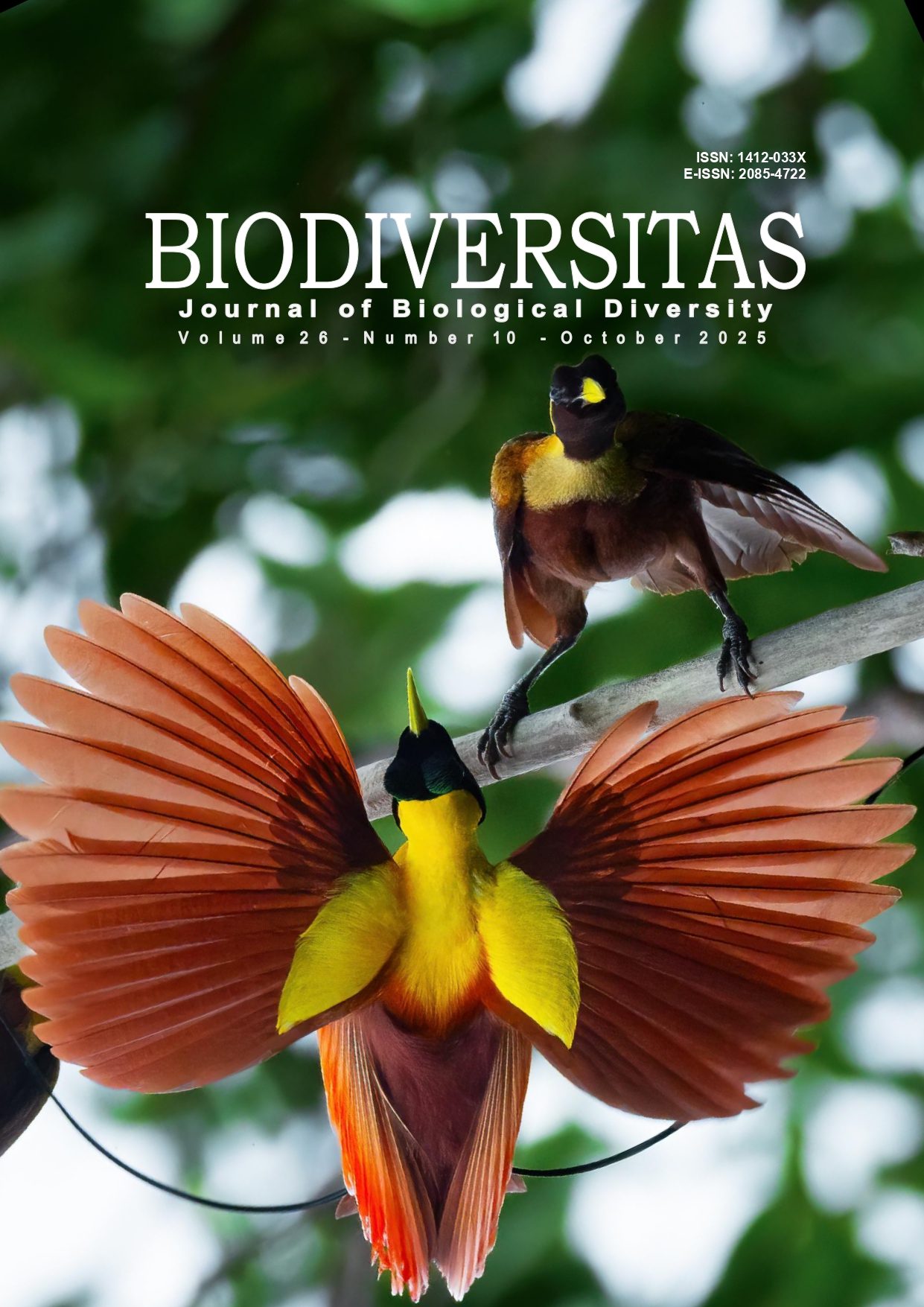
Lek habitat and behavior of the greater bird-of-paradise in South Papua, Indonesia
Article Sidebar
Abstract Views: 318
File Views: 147
Main Article Content
Abstract
Abstract. Mulyani YA, Mardiastuti A, Rahayu P, Murtini. 2025. Lek habitat and behavior of the greater bird-of-paradise in South Papua, Indonesia. Biodiversitas 26: 5057-5066. The greater bird-of-paradise (Paradisaea apoda) is renowned for its extraordinarily beautiful display in its lek mating system. Given the threat posed by this endemic species from hunting and habitat conversion, a conservation effort is critical. However, data on its bio-ecology remain limited. This study aims to describe the characteristics of the lek tree and its surroundings as a lek habitat, and lek behavior, especially concerning the males on the lek trees during courtship display. The research was conducted in a post-logging timber concession company in South Papua in July 2023, through direct observations of behavior and the lek tree habitat. Two lek trees were identified, but observation was focused on one lek tree. The lek tree was a tall, emergent tree of Gironniera sp. (27 m, clear bole height 17 m; diameter 39.7 cm), surrounded by a dense tree canopy. The dominant trees in the lek site included Litsea firma, Vatica rassak, and Syzygium sp., with importance value indices of 41.79%, 31.33%, and 28.17%, respectively. The observation period at the lek tree spanned 7 days, totaling 303 minutes; lekking activity occurred from 6:00 am to 10:00 am and 2:00 to 4:15 pm. The behavior of the male birds could be categorized into arrival of a male host, arrival of other males, arrival of females, initiation of dance rituals by males, male selection by females, mounting and copulation, departure of females, and departure of males. Mounting was observed only twice by a single male. The males’ frequent loud calls during lekking make them highly detectable and prone to illegal hunting. The lek trees in this post-logging area indicated the importance of habitat management for species conservation. Protecting lek habitats by controlling logging operations and developing avitourism initiatives are important approaches to support the conservation of the greater bird-of-paradise and regional biodiversity in South Papua.
Article Details
Issue
Section

This work is licensed under a Creative Commons Attribution-NonCommercial-ShareAlike 4.0 International License.
References
Andersson HL, Cabo J, Karibiah J. 2024. Fruit resources shape sexual selection processes in a lek mating system. Biol Lett 20: 20240284. DOI: 10.1098/rsbl.2024.0284.
Aranzamendi NH, Hall ML, Kingma SA, van de Pol M, Peters A. 2019. Rapid plastic breeding response to rain matches peak prey abundance in tropical savanna bird. J Anim Ecol 88: 1799-1811. DOI: 10.1111/1365-2656.13068.
Beehler B. 1983. Lek behavior of the lesser bird-of-paradise. Auk 100: 992-995. DOI: 10.1093/auk/100.4.992.
Beehler N. 1987. Birds-of-paradise and mating system theory-Predictions and observations. Emu 87: 78-89. DOI: 10.1071/MU9870078.
Berti E, Monsarrat S, Munk M, Jarvie S, Svennig J-C. 2020. Body size is a good proxy for vertebrate charisma. Biol Conserv 251: 108790. DOI: 10.1016/j.biocon.2020.108790.
BirdLife International. 2024. Paradisaea apoda. The IUCN Red List of Threatened Species 2024: e.T22706249A264328824. DOI: 10.2305/IUCN.UK.2024-2.RLTS.T22706249A264328824.en.
Blom MPK, Peona V, Prost S, Christidis L, Benz BW, Jønsson, KA, Suh A, Irestedt M. 2024. Hubridization in birds-of-paradise: Widespread ancestral gene flow despite string sexual selection in lek-mating system. Science 27: 110300. DOI: 10.1016/j.isci.2024.110300.
Coates BJ. 1990. The Birds of Papua New Guinea, Including the Bismarck Archipelago and Bougainville. Dove Publications, United Kingdom.
Colleony A, Clayton S, Couvet D, Jalme MS, Prevot A-C. 2017. Human preferences for species conservation: Animal charisma trumps endangered data. Biol Conserv 206: 263-269. DOI: 10.1016/j.biocon.2016.11.035.
Dinsmore JJ. 1970. Courtship behavior of the greater bird-of-paradise. Auk 87: 305-321. DOI: 10.2307/4083922.
Franca FM, Beiroz W, Andretti CB, Costa TVV, Vaz-De-Mello FZ, Silveira JM, Louzada J. 2024. Selective logging intensity and time since logging drive tropical bird and dung beetle diversity: A case study from Amazonia. Environ Conserv 51: 112-121. DOI: 10.1017/S0376892923000334.
Frith CB, Beehler BM. 1997. Courtship and mating behaviour of the twelve-wired bird of paradise Seleucidis melanoleuca. Emu 97: 133-140. DOI: 10.1071/MU97017.
Frith CB, Frith DW. 2009. Family Paradisaeidae (Birds-of-paradise). In: del Hoyo JEA, Christie DA (eds). Handbook of the Birds of the World. Lynx Edicions, Barcelona.
Indrawan M, Sumule A, Wijaya A, Kapisa N, Wanggai F, Ahmad M, Mambai BV, Heatubun C. 2019. A time for locally driven development in Papua and West Papua. Dev Pract 29 (1): 1-7. DOI: 10.1080/09614524.2019.1609907.
Irestedt M, Jonsson KA, Fjeldsa J, Christidis L, Ericson Per GP. 2009. An unexpectedly long history of sexual selection in birds-of-paradise. BMC Evol Biol 9: 1-11. DOI: 10.1186/1471-2148-9-235.
Kempenaers B. 2022. Mating system in birds. Curr Biol 32: R1042-R1172. DOI: 10.1016/j.cub.2022.09.046.
Krause M, Robinson K. 2017. Charismatic species and beyond: How cultural schemes and organisational routines shape conservation. Conserv Soc 15 (3): 313-321. DOI: 10.4103/cs.cs_16_63.
Krebs JR, Davies NB. 1978. Behavioral Ecology: An Evolutionalry Approach. Sinauer, Sunderland.
Lahallo W, Tanjung RHR, Suharno, Sujarta P. 2022. Diversity, composition, and important tree species for cendrawasih bird activities in Rhepang Muaif ecotourism forest, Jayapura, Papua. Indonesia. Biodiversitas 23 (2): 215-223. DOI: 10.13057/biodiv/d230219.
Latupapua L, Pattinasarany CK, Kasanaborbir L. 2022. Habitat and population of greater bird-of-paradise (Paradisaea apoda) in Laininir Village, Trangan Island, Aru Selatan District, Aru Islands Regency. Jurnal Hutan Tropis 10: 150-158. DOI: 10.20527/jht.v10i2.14124.
Ligon RA, Diaz CD, Morano JL. Troscianko J, Stevens M, Moskeland A, Laman TG, Scholes E. 2018. Evolution of correlated complexity in the radically different courtship signals of birds-of-paradise. Plos Biol 16: e2006962. DOI: 10.1371/journal.pbio.2006962.
Macdonald EA, Burnham D, Hinks AE, Dickman AJ, Malhi Y, Macdonald DW. 2015. Conservation inequality and the charismatic cat: Felis felicis. Glob Ecol Conserv 3: 851-866. DOI: 10.1016/j.gecco.2015.04.006.
Mardiastuti A, Mulyani YA. 2024a. Hunting and trade in Papuan bird-of-paradise: current situation and sustainability. IOP Conf Ser Earth Environ Sci 1359 (1): 12099. DOI: 10.1088/1755-1315/1359/1/012099.
Mardiastuti A, Mulyani YA. 2024b. Responsible tourism in birdwatching and wild bird photography. IOP Conf Series Earth Environ Sci 1366: 012027. DOI: 10.1088/1755-1315/1366/1/012027.
Martin PR. 2015. The paradox of the birds-of-paradise. Ideas Ecol Evol 8: 58-66. doi: 10.4033/iee.2015.8.10.
Miles MC, Fuxjager M. 2018. Synergistic selection regimes drive the evolution of display complexity in birds-of-paradise. J Anim Ecol 87: 1149-1159. DOI: 10.1111/1365-2656.12824.
Mueller-Dombois D, Ellenberg H. 1974. Aims and Methods of Vegetation Ecology. John Wiley and Sons, New York.
Pattiselano F, Krockenberger A. 2021. Road development and indigenous hunting in Tanah Papua: Connecting the facts for future wildlife conservation agendas. For Soc 5 (1): 181-189. DOI: 10.24259/fs.v5i1.12528.
Pramunandya RA, Mardiastuti A, Mulyani YA, Chandra V. 2024. The display behavior of sub-adult greater bird-of-paradise (Paradisaea apoda): A learning process from an adult? J Nat Resour Environ Manag 14 (3): 505-515. DOI: 10.29244/jpsl.14.3.505.
Pratt TK, Beehler BM. 2015. Birds of New Guinea. Second Edition Princeton University Press, Princeton. DOI: 10.1515/9781400865116.
Prokop P, Zvarikova M, Zvarik M, Ježova Z, Fedor P. 2022. Charismatic species should be large: The role of admiration and fear. People Nat 6: 945-957. DOI: 10.1002/pan3.10504.
Prost S, Armstrong EE, Nylander J, Thomas GWC, Suh A, Petersen B, Dalen L, Benz BW, Blom MPK, Palkopoulou E. 2019. Comparative analyses identify genomic features potentially involved in the evolution of birds-of-paradise. Gigascience 8 (5): giz003. DOI: 10.1093/gigascience/giz003.
Pruett-Jones SG, Pruett-Jones MA .1990. Sexual selection through female choice in Lawes' Protia, a lek-mating bird-of-paradise. Evolution 44: 486-501. DOI: 10.1111/j.1558-5646.1990.tb05934.x.
Rathore A, Isvaran K, Guttal V. 2022. Lekking as collective behaviour. Phil Trans R Soc B 378: 20220066. DOI: 10.1098/rstb.2022.0066.
Raunsay EK, Akobiarek MR, Kawatu PJ, Tanta T. 2023. Pohon bermain burung cenderawasih kuning besar (Paradisaea apoda) di Hutan Kampung Katan Distrik Obaa Kabupaten Mappi Provinsi Papua. Al-Kauniyah 16 (1): 166-182. DOI: 10.15408/kauniyah.v16i1.2285. [Indonesian]
Raunsay EK, Rehiara RE, Nurcholis W. 2025. Conservation challenges of birds-of-paradise in Papua, Indonesia. Braz J Biol 85: e289477. DOI: 10.1590/1519-6984.28947.
Robin CS. 1981. Bird activity levels related to weather. Stud Avian Biol 6: 301-310.
Scholes E, Gillis JM, Laman TG. 2017. Visual and acoustic components of courtship in the bird-of-paradise genus Astrapia (Aves: Paradisaeidae). PeerJ 5: e3987. DOI: 10.7717/peerj.3987.
Scholes E. 2020. Analysis: The Forest Home of the Birds-of-Paradise is Disappearing Fast. Living Birds Winter. www.allaboutbirds.org/news/living-bird-winter-2021-table-of-contents/.
Ucero A, Alonso JC, Palacin C, Abril-Colón I, Álvarez-Martinez JM. 2023. Display site selection in a ground-dwelling bird: The importance of viewshed. Behav Ecol 34 (2): 223-235. DOI: 10.1093/beheco/arac112.
van Balen B, Kilmaskossu A, Puradyatmika P. 2015. A Guide to the Birds of the Mimika Region Papua, Indonesia. PT Freeport Indonesia, Papua.
Vervoort R, Kempenaers B. 2019. Variation in lek attendance and copulation success of Independent and satellite male Ruffs Calidris pugnax. Ardea 107 (3): 303-320. DOI: 10.5253/arde.v107i3.a9.