Flowering, fruit set and breeding systems of Habenaria janellehayneana and H. rhodocheila in Phu Hin Rong Kla National Park, Thailand
Article Sidebar
Abstract Views: 297
File Views: 15
Main Article Content
Abstract
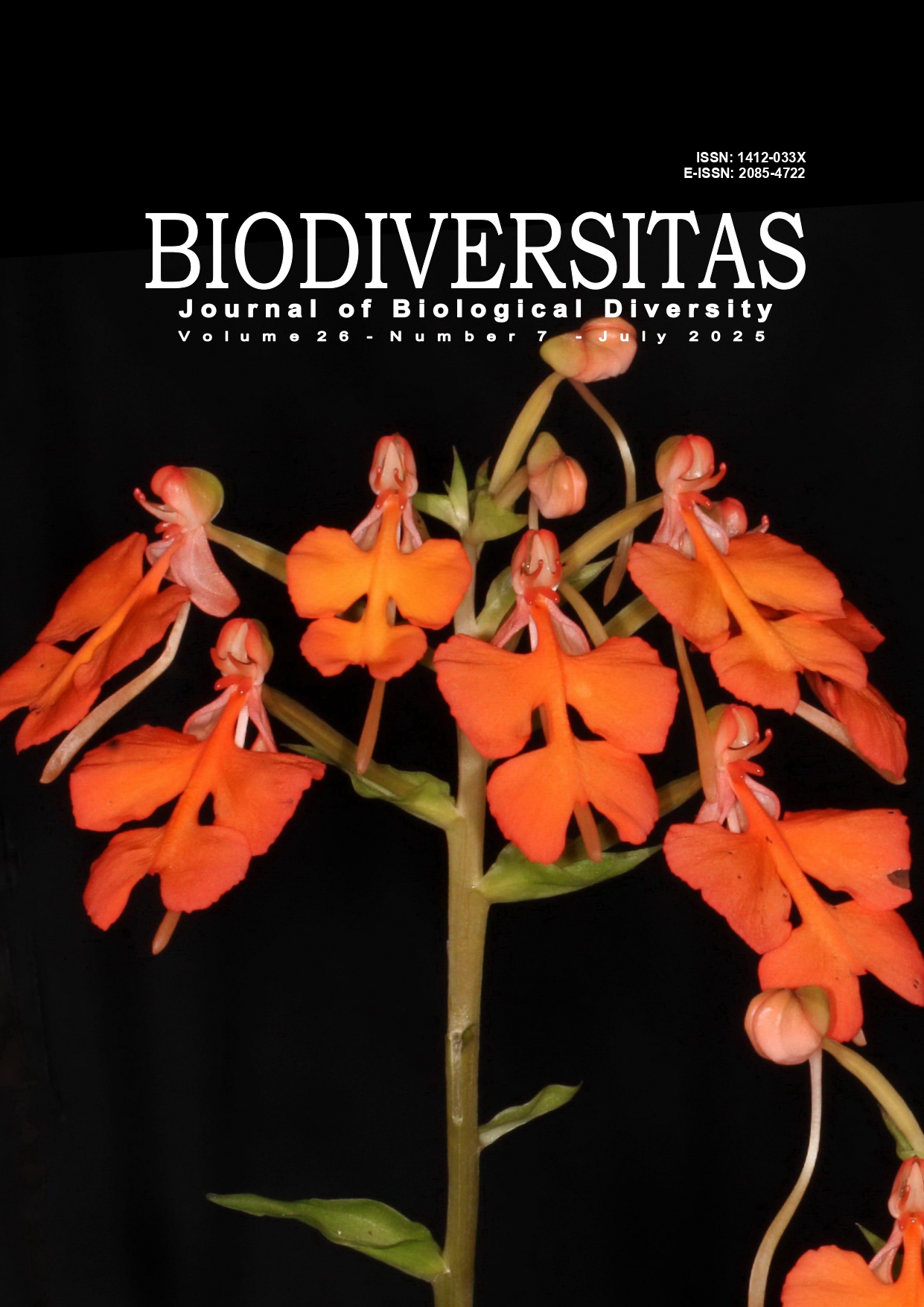
Abstract. Thummavonsa T, Musimun C, Watthana S, Muangsan N. 2025. Flowering, fruit set and breeding systems of Habenaria janellehayneana and H. rhodocheila in Phu Hin Rong Kla National Park, Thailand. Biodiversitas 26: 3246-3251. Reproductive biology studies are important information for orchids conservation in natural habitats, especially ones which have high potential for economic use. Over-collection is a main threat of orchid species with economic value. Moreover, the reduction of the habitat and climate change may result in population decline or extinction. Fruit set data is a preliminary evaluating the population survival, valuable for population conservation. This study aimed to examine flowering, natural fruit set and breeding systems of Habenaria janellehayneana and H. rhodocheila, attractive terrestrial orchids for pot plants, in Phu Hin Rong Kla National Park, Phitsanulok Province, Northern Thailand to collect basic information for in situ conservation. Two studied plots, 50x50 m plots of each species, were established to investigate the flowering and fruit set. Three experiments of hand-pollination, untouched, self- and cross-pollination were performed to compare with natural pollination to determine the breeding systems. Leaf length and shoot length showed no correlation with fruit set (r<0.5), while the number of flowers per inflorescence was slightly correlated (r=0.6). This result indicates that plant size is not a factor for fruit production, but the number of flowers per inflorescence is likely to be the factor to attract the pollinator. Natural fruit set is notably high in both species as they are nectar-rewarding species. Both species exhibited genetically self-incompatibility and non-autogamous but required pollinators for successful reproduction. Habenaria janellehayneana is firstly reported on its breeding system and fruit set, exhibiting as the main traits of the genus Habenaria. Moderately high number of fruit set in both species indicated that no pollinator scarcity. Maintaining the ecosystem of their habitat is necessary for conserve these orchid populations.
Article Details
Issue
Section

This work is licensed under a Creative Commons Attribution-NonCommercial-ShareAlike 4.0 International License.
References
Ackerman JD, Phillips RD, Tremblay RL, Karremans A, Reiter N, Peter CI, Bogarín D, Pérez-Escobar OA, Liu H. 2023. Beyond the various contrivances by which orchids are pollinated: Global patterns in orchid pollination biology. Bot J Linn Soc 202 (3): 295-324. DOI: 10.1093/botlinnean/boac082.
Balducci MG, van der Niet T, Johnson SD. 2019. Butterfly pollination of Bonatea cassidea (Orchidaceae): Solving a puzzle from the Darwin era. S Afr J Bot 123: 308-316. DOI: 10.1016/j.sajb.2019.03.030.
Charlesworth D, Willis JH. 2009. The genetics of inbreeding depression. Nat Rev Genet 10 (11): 783-796. DOI: 10.1038/nrg2664.
Chen M, Zhang G, Luo Y, Chen X, Liu Z. 2021a. Pollination biology and reproductive ecology of Habenaria species in China. Plant Divers 43 (5): 333-345. DOI: 10.1002/ece3.7242.
Chen XH, Tan SL, Liang YL, Huang L, Xiao HW, Luo HL, Xiong DJ, Yang BY, Ren ZX. 2021b. The pollination of Habenaria rhodocheila (Orchidaceae) in South China: When butterflies take sides. Ecol Evol 11 (6): 2849-2861. DOI: 10.1002/ece3.7242.
Choltco TC, Moloney B, Yong G. 2017. A new Habenaria from Northern Thailand (Subfamily: Orchidoideae Tribe: Orchideae Subtribe: Orchidinae). Orchideen J 4 (5): 1-4.
Gandawidjaja D, Arditti J. 1982. Post-pollination phenomena in orchid flowers. XI. Autogamy in Phajus tankervilliae (Aiton) Blume, Orchidaceae. American Journal of Botany 69(3): 335-338. DOI: 10.1002/j.1537-2197.1982.tb13265.x.
Hinsley A, Boer HJ, Fay MF, Gale SW, Gardiner LM, Gunasekara RS, Kumar P, Masters S, Metusala D, Roberts DL, Veldman S, Wong S, Phelps J. 2018. A review of the trade in orchids and its implications for conservation. Bot J Linn Soc 186 (4): 435-455. DOI: 10.1093/botlinnean/box083.
Kurzweil H. 2011. Habenaria Willd. In: Santisuk T, Larsen K (eds). Flora of Thailand. The Forest Herbarium, Department of National Parks, Wildlife and Plant Conservation, Bangkok, Thailand.
Neiland MR, Wilcock CC. 1998. Fruit set, nectar reward, and rarity in the Orchidaceae. Am J Bot 85 (12): 1657. DOI: 10.2307/2446499.
Pedron M, Buzatto CR, Singer RB, Batista JAN, Moser A. 2012a. Pollination biology of four sympatric species of Habenaria (Orchidaceae: Orchidinae) from southern Brazil. Bot J Linn Soc 170: 141-156. DOI: 10.1111/j.1095-8339.2012.01285.x.
Pedron M, Galetto L, Singer RB. 2012b. Pollination biology of Habenaria jaguariahyvae and Habenaria bractescens (Orchidaceae) in south-eastern Brazil. Plant Species Biol 27 (2): 93-101.
Phelps J, Webb EL. 2015. Invisible wildlife trades: Southeast Asia’s undocumented illegal trade in wild ornamental plants. Biol Conserv 186: 296-305. DOI: 10.1016/j.biocon.2015.03.030.
Phillips RD, Reiter N, Pealall R. 2020. Orchid conservation: From theory to practice. Ann Bot 126: 345-362. DOI: 10.1093/aob/mcaa093.
POWO. 2024. Plants of the World Online. Royal Botanic Gardens, Kew. https://powo.science.kew.org/.
Reyes H, Draper D, Marques I. 2021. Pollination in the rainforest: Scarce visitors and low effective pollinators limit the fruiting success of tropical orchids. Insects 12 (10): 856. DOI: 10.3390/insects12100856.
Rodger JG, Ellis AG. 2016. Distinct effects of pollinator dependence and self-incompatibility on pollen limitation in South African biodiversity hotspots. Biol Lett 12: 253. DOI: 10.1098/rsbl.2016.0253.
Srimuang K, Watthana S, Pedersen HÆ, Rangsayatorn N, Eungwanichayapant PD. 2010. Flowering phenology, floral display, and reproductive success in the genus Sirindhornia (Orchidaceae): A comparative study of three pollinator-rewarding species. Ann Bot Fenn 47: 439-448. DOI: 10.5735/085.047.0603.
Tao Z, Ren, Z-X, Bernhardt P, Huan L, Li H-D, Wang H. 2018. Nocturnal hawkmoth and noctuid moth pollination of Habenaria limprichtii (Orchidaceae) in sub-alpine meadows of the Yulong Snow Mountain (Yunnan, China). Bot J Linn Soc 187 (3): 483-489. DOI: 10.1093/botlinnean/boy023/5037747.
Thummavongsa T, Musimun C, Watthana S, Gale S, Choeyklin R, Wiriyathanawudhiwong N, Muangsan N. 2024. Enhancing germination of Habenaria janellehayneana (Orchidaceae): Insight from asymbiotic and symbiotic methods. Plants Ornam J 14 (1): 11-23.
Thummavongsa T, Watthana, S, Musimun C, Muangsan N. 2022. Asymbiotic germination of Habenaria rhodocheila Hance on different culture media and impact of plant growth regulators. Asia Pac J Sci Technol 27 (5): 1-9. DOI: 10.14456/apst.2022.82.
Tinoammini N, Aazhivaendhan G, Rajasekar C, Siva G, Senthil KT, Muthukumar M. 2024. Medicinal Orchids of genus Habenaria. In: Husen A, Pant M (eds). Exploring Medicinal Orchids. CRC press, Boca Raton. DOI: 10.1201/9781003436638-10.
Travers SE, Anderson K, Vitt P, Harris MO. 2018. Breeding system and inbreeding depression in the rare orchid, Platanthera praeclara, in a fragmented grassland landscape. Botany 96 (3): 151-159. DOI: 10.1139/cjb-2017-0104.
Tremblay RL, Ackerman JD, Zimmerman JK, Calvo RN. 2005. Variation in sexual reproduction in orchids and its evolutionary consequences: A spasmodic journey to diversification. Biol J Linn Soc 84 (1): 1-54. DOI: 10.1111/j.1095-8312.2004.00400.x.
Williams C, Watthana S. 2011. The pollination of Habenaria rhodocheila: A study trip to the forests of Northern Thailand to see the habitats of H. lindleyana, H. lucida and H. limprichtii. Orchid Rev 119: 206-213.
Xiong YZ, Jia LB, Liu CQ, Huang SQ. 2019. Effective pollinia transfer by settling moths’ legs in an orchid Habenaria aitchisonii. J Syst Evol 58: 174-181. DOI: 10.1111/jse.12485.
Zhang W, Gao J. 2021. A comparative study on the reproductive success of two rewarding Habenaria species (Orchidaceae) occurring in roadside verge habitats. BMC Plant Biol 21 (1): 187. DOI: 10.1186/s12870-021-02968-w.
Zhang WL, Gao JY. 2017. Multiple factors contribute to reproductive isolation between two co-existing Habenaria species (Orchidaceae). Plos One 12: e0188594. DOI: 10.1371/journal.pone.0188594.
Zhang WL, Gao JY. 2018. High fruit sets in a reward less orchid: A case study of obligate agamospermy in Habenaria. Aust J Bot 66 (2): 144-151. DOI: 10.1071/BT17182.
Zhang Z, Cui X, Zhou J, Huang C, Deng J, Tang X, Luo S. 2021. Pollination of the Orchid Habenaria rhodocheila by the swallowtail butterfly Papilio helenus in Subtropical Evergreen broad-leaved forests in Southern China. Flora 274: 151736. DOI: 10.1016/j.flora.2020.151736.