Molecular identification of peacock bass (Cichla ocellaris) from the Bedog River, Yogyakarta, Indonesia
Article Sidebar
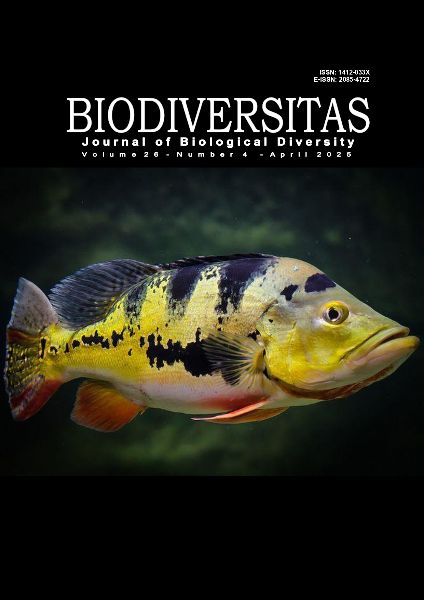
Abstract Views: 675
File Views: 124
Main Article Content
Abstract
Abstract. Andriyono S, Akhmad H, Alam MJ, Dewi NN, Lutfiyah L, Suciyono. 2025. Molecular identification of peacock bass (Cichla ocellaris) from the Bedog River, Yogyakarta, Indonesia. Biodiversitas 26: 1565-1572. The introduction of non-native fish species can lead to the establishment of invasive species groups that pose environmental threats and contribute to biodiversity loss. The primary aim of this study was the precise molecular identification of specific Cichla spp. from the Bedog River in Yogyakarta. Seven Cichla fish samples were collected from the Bedog River (upstream and downstream area) from August to October 2020 using a fish net. The cytochrome C Oxidase subunit I (COI) gene region serves as the basis for species identification, with comparisons made against the National Center for Biotechnology Information (NCBI) database. In this study, the primers used in PCR were Universal Fish BCL-BCH primers. The PCR results were followed by sequencing using the Sanger platform. Of the seven samples procured from the Bedog River, all unequivocally indicated the presence of the Cichla species, identified explicitly as Cichla ocellaris (99.68-100% similarity to reference NC030272). Furthermore, upon phylogenetic tree construction, these sequences consistently clustered with C. ocellaris and Cichla temensis sequences. Nevertheless, discerning characteristics of the color pattern align more closely with C. ocellaris. The identification of non-native species in the Bedog River underscores the imperative for vigilant monitoring of fish introductions to avert potential harm to indigenous fish populations. The predatory nature of C. ocellaris raises concerns about its capacity to exert pressure on local fish populations, potentially culminating in its invasive establishment—a phenomenon with deleterious implications for tropical fish biodiversity in Indonesia. DNA Barcode applications are essential in supporting the provision of accurate data and in preventing the illegal spread of non-native fish.
Article Details
Issue
Section

This work is licensed under a Creative Commons Attribution-NonCommercial-ShareAlike 4.0 International License.
References
Achmad H, Martini L, Wibowo SA, Nugroho L. 2018. Sebaran, potensi, introduksi, dan pengendalian ikan berbahaya/invasif dan berpotensi invasif di Yogyakarta dan sekitarnya. Jurnal Penelitian Perikanan Indonesia 24: 61-72. DOI: 10.15578/jppi.1.1.2018.61-72. [Indonesian]
Achmad H, Novianto H. 2019. Sebaran dan potensi pelepasliaran ikan asing melalui rekreasi memancing dan upaya pengendaliannya di Yogyakarta. Prosiding Seminar Nasional III Pascasarjana UNS. [Indonesian]
Achmad H, Wibowo SA, Rahman H. 2020. Peningkatan persepsi positif publik dalam pencegahan pelepasliaran ikan asing invasif di Yogyakarta dan sekitarnya. Quarantamina 2 (1): 13-32. [Indonesian]
Akmal SG, Yonvitner, Jerikho R, Yulianda F, Wardiatno Y, Novák J, Kalous L, Slavík O, Patoka J. 2022. Culture, trade and establishment of Polypterus senegalus in Indonesia with first record of wild populations. Aquac Environ Interact 14: 127-133. DOI: 10.3354/aei00433.
Andriyono S, Fitrani M. 2021. Non-native species existence and its potency to be invasive species on freshwater ecosystem in East Java province, Indonesia. Egypt J Aquat Biol Fish 25: 1013-1024. DOI: 10.21608/ejabf.2021.170621.
Anggraini A, Sudarsono S, Sukiya S. 2016. Kelimpahan dan tingkat kesuburan plankton di Perairan Sungai Bedog. Kingdom J Biol Stud 5 (6): 1-9. DOI: 10.21831/kingdom.v5i6.5923. [Indonesian]
Antil S, Abraham JS, Sripoorna S, Maurya S, Dagar J, Makhija S, Bhagat P, Gupta R, Sood U, Lal R, Toteja R. 2023. DNA barcoding, an effective tool for species identification: A review. Mol Biol Rep 50 (1): 761-775. DOI: 10.1007/s11033-022-08015-7.
Ardura A, Linde AR, Moreira JC, Garcia-Vazquez E. 2010. DNA barcoding for conservation and management of Amazonian commercial fish. Biol Conserv 143: 1438-1443. DOI: 10.1016/j.biocon.2010.03.019.
Baldwin CC, Castillo CI, Weigt LA, Victor BC. 2011. Seven new species within western Atlantic Starksia atlantica, S. lepicoelia, and S. sluiteri (Teleostei, Labrisomidae), with comments on congruence of DNA barcodes and species. ZooKeys 3: 21-72. DOI: 10.3897/zookeys.79.1045.
Bbole I, Katongo C, Deines AM, Shumba O, Lodge DM. 2014. Hybridization between non-indigenous Oreochromis niloticus and native Oreochromis species in the lower Kafue River and its potential impacts on fishery. J Ecol Nat Environ 6 (6): 215-225. DOI: 10.5897/jene2014.0444.
Breman FC, Loix S, Jordaens K, Snoeks J, Van Steenberge M. 2016. Testing the potential of DNA barcoding in vertebrate radiations: The case of the littoral cichlids (Pisces, Perciformes, Cichlidae) from Lake Tanganyika. Mol Ecol Resour 16 (6): 1455-1464. DOI: 10.1111/1755-0998.12523.
Coffill?Rivera ME, Neal JW, Allen PJ. 2022. Effects of temperature on growth of juvenile speckled peacock bass Cichla temensis. N Am J Aquac 84 (4): 486-492. DOI: 10.1002/naaq.10262.
Collins RA, Cruickshank RH. 2013. The seven deadly sins of DNA barcoding. Mol Ecol Resour 13 (6): 969-975. DOI: 10.1111/1755-0998.12046.
De Campos CP, de Carvalho Freitas CE, Amadio S. 2015. Growth of the Cichla temensis Humboldt, 1821 (Perciformes: Cichlidae) from the middle rio Negro, Amazonas, Brazil. Neotrop Ichthyol 13 (2): 413-420. DOI: 10.1590/1982-0224-20140090.
Deines AM, Bbole I, Katongo C, Feder JL, Lodge DM. 2014. Hybridisation between native Oreochromis species and introduced Nile tilapia O. niloticus in the Kafue River, Zambia. Afr J Aquat Sci 39 (1): 23-34. DOI: 10.2989/16085914.2013.864965.
Djumanto D, Pranoto BE, Diani VS, Setyobudi E. 2017. Makanan dan pertumbuhan ikan Bandeng, Chanos chanos (Forsskål, 1775) tebaran di Waduk Sermo, Kulon Progo. J Iktiologi Indonesia 17 (1): 83-100. DOI: 10.32491/jii.v17i1.306. [Indonesian]
DKP Kab Gunungkidul. 2019. Waspadalah Terhadap TILV (Tilapia Lake Virus). https://dkp.gunungkidulkab.go.id/berita-289/waspadalah-terhadap-tilv-tilapia-lake-virus.html). [Indonesian]
Duong T-Y, Nguyen N-TT, Nguyen TT, Huynh LTT, Bui TM, Pham LT, Dunham R. 2022. Growth and survival of crossbreeds between wild and domestic strains of Mekong Delta bighead catfish (Clarias macrocephalus Günther, 1864) cultured in tanks. Aquaculture 547: 737507. DOI: 10.1016/j.aquaculture.2021.737507.
Duong T-Y, Nguyen T-T, Pham T-L. 2017. Morphological differentiation among cultured and wild Clarias macrocephalus, C. macrocephalus x C. gariepinus hybrids, and their parental species in the Mekong delta, Viet Nam. Intl J Fish Aquat Stud 5 (1): 233-240.
Espínola LA, Minte-Vera CV, Júlio Jr HF. 2010. Invasibility of reservoirs in the Paraná Basin, Brazil, to Cichla kelberi Kullander and Ferreira, 2006. Biol Invasions 12: 1873-1888. DOI: 10.1007/s10530-009-9598-x.
Espínola LA, Minte-Vera CV, Junior HFJ, Santos LN, Winemiller KO. 2014. Evaluation of factors associated with dynamics of Cichla ocellaris invasion of the Upper Paraná River floodplain system, Brazil. Mar Freshw Res 66 (1): 33-40. DOI: 10.1071/MF13105.
Fadjar M, Islamy RA, Herawati EY. 2019. First record of Arapaima gigas (Schinz, 1822) (Teleostei: Osteoglossomorpha), in the Brantas River, Sidoarjo, East Java, Indonesia. Biodiversitas 20 (12): 3527-3531. DOI: 10.13057/biodiv/d201209.
Fauzia AZ, Suhartini S, Sudarsono S. 2016. Kualitas perairan di Sungai Bedog, Yogyakarta berdasarkan keanekaragaman plankton. Jurnal Biologi 5 (6): 50-61. [Indonesian]
Franco ACS, dos Santos LN, Petry AC, García-Berthou E. 2018. Abundance of invasive peacock bass increases with water residence time of reservoirs in southeastern Brazil. Hydrobiologia 817: 155-166. DOI: 10.1007/s10750-017-3467-x.
Harper GA, Bunbury N. 2015. Invasive rats on tropical islands: Their population biology and impacts on native species. Glob Ecol Conserv 3: 607-627. DOI: 10.1016/j.gecco.2015.02.010.
Haryono, Wahyudewantoro G, Walidi W, Tani DD, Anggraeni Y, Arta AP, Supardan A. 2016. Jenis Ikan Invasif, Ancaman dan Pengendaliannya. Bidang Keamanan Hayati Ikan, Pusat Karantina dan Keamanan Hayati Ikan, Kementerian Kelautan dan Perikanan, Bekerjasama dengan Pusat Penelitian Biologi-LIPI, Jakarta. [Indonesian]
Hasan V, Widodo MS, Islamy RA, Pebriani DAA. 2020. New records of Alligator gar, Atractosteus spatula (Actinopterygii: Lepisosteiformes: Lepisosteidae) from Bali and Java, Indonesia. Acta Ichthyol Piscat 50 (2): 233-236. DOI: 10.3750/AIEP/02954.
Hebert PDN, Cywinska A, Ball SL, deWaard JR. 2003. Biological identifications through DNA barcodes. Proc Biol Sci 270 (1512): 313-321. DOI: 10.1098/rspb.2002.2218.
Heemstra PC. 1993. Groupers of the World (Family Serranidae, Subfamily Epinephelinae). An Annotated and Illustrated Catalogue of the Grouper, Rockcod, Hind, Coral Grouper and Lyretail Species Known to Date. FAO Species Catalogue 16, FAO, Rome, Italy.
Herder F, Möhring J, Flury JM, Utama IV, Wantania L, Wowor D, Boneka FB, Stelbrink B, Hilgers L, Schwarzer J, Pfaender J. 2022. More non-native fish species than natives, and an invasion of Malawi cichlids, in ancient Lake Poso, Sulawesi, Indonesia. Aquat Invasions 17 (1): 72-91. DOI: 10.3391/ai.2022.17.1.05.
Herder F, Schliewen UK, Geiger MF, Hadiaty RK, Gray SM, McKinnon JS, Walter RP, Pfaender J. 2012. Alien invasion in Wallace's Dreamponds: Records of the hybridogenic" flowerhorn" cichlid in Lake Matano, with an annotated checklist of fish species introduced to the Malili Lakes system in Sulawesi. Aquat Invasions 7 (4): 521-535. DOI: 10.3391/ai.2012.7.4.009.
Hubert N, Hanner R. 2015. DNA barcoding, species delineation and taxonomy: A historical perspective. DNA Barcodes 3 (1): 44-58. DOI: 10.1515/dna-2015-0006.
Ika SR, Syamsiro M, Mulyono A. 2021. Penerapan teknologi pembuatan pakan untuk pemberdayaan kelompok peternak ikan hias di kota Yogyakarta. In: Seminar Nasional Karya Pengabdian. [Indonesian]
Khaleel AG, Ismail N, Ahmad-Syazni K. 2021. Introduction of invasive peacock bass (Cichla spp.), its rapid distribution and future impact on freshwater ecosystem in Malaysia. Croat J Fish 79 (1): 33-46. DOI: 10.2478/cjf-2021-0004.
Khaleel AG, Nasir SAM, Ismail N, Ahmad-Syazni K. 2020. Origin of invasive fish species, peacock bass Cichla species in Lake Telabak Malaysia revealed by mitochondrial DNA barcoding. Egypt J Aquat Biol Fish 24 (3): 311-322. DOI: 10.21608/ejabf.2020.92251.
Kiruba-Sankar R, Raj JP, Saravanan K, Kumar KL, Angel JRJ, Velmurugan A, Roy SD. 2018. Invasive species in freshwater ecosystems-Threats to ecosystem services. In: Sivaperuman C, Velmurugan A, Singh AK, Jaisankar I (eds). Biodiversity and Climate Change Adaptation in Tropical Islands. Academic Press, London, UK. DOI: 10.1016/B978-0-12-813064-3.00009-0.
Kumar S, Stecher G, Li M, Knyaz C, Tamura K. 2018. MEGA X: Molecular Evolutionary Genetics Analysis across computing platforms. J Mol Biol Evol 35 (6): 1547-1549. DOI: 10.1093/molbev/msy096.
Lakra WS, Verma MS, Goswami M, Lal KK, Mohindra V, Punia P, Gopalakrishnan A, Singh KV, Ward RD, Hebert P. 2011. DNA barcoding Indian marine fishes. Mol Ecol Resour 11 (1): 60-71. DOI: 10.1111/j.1755-0998.2010.02894.x.
Lin M, Mu X, Yan X. 2017. The complete mitochondrial genome of Cichla ocellaris. Mitochondrial DNA B Resour 2 (2): 620-622. DOI: 10.1080/23802359.2017.1372713.
Lyon JP, Tonkin Z, Moloney PD, Todd C, Nicol S. 2018. Conservation implications of angler misidentification of an endangered fish. Aquat Conserv: Mar Freshw Ecosyst 28: 1396-1402. DOI: 10.1002/aqc.2980.
Maixenchs M, Anselmo R, Pérez GM, Oruko K, Agnandji ST, Minsoko PCA, Diarra K, Djiteye M, Bhutta ZA, Zaidi S, Carrilho C, Sanz A, Ordi J, Menendez C, Bassat Q, Munguambe K. 2019. Socio-anthropological methods to study the feasibility and acceptability of the minimally invasive autopsy from the perspective of local communities: Lessons learnt from a large multi-centre study. Glob Health Action 12: 1559496. DOI: 10.1080/16549716.2018.1559496.
Mourão AAF, Freitas-Souza D, Hashimoto DT, Ferreira DC, do Prado FD, Silveira RV, Foresti F, Porto-Foresti F. 2017. Molecular and morphological approaches for species delimitation and hybridization investigations of two Cichla species. Iheringia. Sér Zool 107: e2017016. DOI: 10.1590/1678-4766e2017016.
Pelicice FM, Agostinho AA. 2009. Fish fauna destruction after the introduction of a non-native predator (Cichla kelberi) in a Neotropical reservoir. Biol Invasions 11: 1789-1801. DOI: 10.1007/s10530-008-9358-3.
Rachmatika I, Wahyudewantoro G. 2006. Jenis-jenis ikan introduksi di perairan tawar Jawa Barat dan Banten: Catatan tentang taksonomi dan distribusinya. Jurnal Iktiologi Indonesia 6 (2): 93-97. DOI: 10.32491/jii.v6i2.225. [Indonesian]
Rahim KAA, Esa Y, Arshad A. 2013. The influence of alien fish species on native fish community structure in Malaysian waters. Kuroshio Sci 7 (1): 81-93.
Saba AO, Ismail A, Zulkifli SZ, Shohaimi S, Jamil NR, Nawi NM, Ghani IFA, Halim MRA, Amal MNA. 2020. Checklists, production trends, and potential ecological and socioeconomic impacts of non-native freshwater fishes in Malaysia: A review. Aquat Invasions 15 (4): 646-670. DOI: 10.3391/ai.2020.15.4.07.
Sastraprawira SM, Razak IHA, Shahimi S, Pati S, Edinur HA, John AB, Ahmad A, Kumaran JV, Martin MB, Chong JL, Chowdhury AJK, Nelson BR. 2020. A review on introduced Cichla spp. and emerging concerns. Heliyon 6: e05370. DOI: 10.1016/j.heliyon.2020.e05370.
Sentosa AA, Hedianto DA. 2020. Gillnets selectivity and effectivity for controlling invasive fish species in Lake Matano, South Sulawesi. IOP Conf Ser: Earth Environ Sci 535: 012039. DOI: 10.1088/1755-1315/535/1/012039.
Serdiati N, Yonarta D, Pratama FS, Faqih AR, Valen FS, Tamam MB, Hamzah YIG, Hasan V. 2020. Andinoacara rivulatus (Perciformes: Cichlidae), an introduced exotic fish in the upstream of Brantas River, Indonesia. AACL Bioflux 13: 137-141.
Tadmor-Levi R, Cummings D, Borovski T, Shapira R, Marcos-Hadad E, David L. 2022. A method for quick and efficient identification of cichlid species by high resolution DNA melting analysis of minibarcodes. Front Ecol Evol 10: 1010838. DOI: 10.3389/fevo.2022.1010838.
Tarkan AS, Vilizzi L, Top N, Ekmekçi FG, Stebbing PD, Copp GH. 2017. Identification of potentially invasive freshwater fishes, including translocated species, in Turkey using the Aquatic Species Invasiveness Screening Kit (AS?ISK). Intl Rev Hydrobiol 102 (1-2): 47-56. DOI: 10.1002/iroh.201601877.
Umar C, Sulaiman PS. 2013. Status introduksi ikan dan strategi pelaksanaan secara berkelanjutan di perairan umum daratan di Indonesia. Jurnal Kebijakan Perikanan Indonesia 5: 113-120. DOI: 10.15578/jkpi.5.2.2013.113-120. [Indonesian]
Vitule JRS, Skóra F, Abilhoa V. 2012. Homogenization of freshwater fish faunas after the elimination of a natural barrier by a dam in Neotropics. Divers Distrib 18 (2): 111-120. DOI: 10.1111/j.1472-4642.2011.00821.x.
Willis SC, Macrander J, Farias IP, Ortí G. 2012. Simultaneous delimitation of species and quantification of interspecific hybridization in Amazonian peacock cichlids (genus Cichla) using multi-locus data. BMC Evol Biol 12: 96. DOI: 10.1186/1471-2148-12-96.
Willis SC, Winemiller KO, Montaña CG, Macrander J, Reiss P, Farias IP, Ortí G. 2015. Population genetics of the speckled peacock bass (Cichla temensis), South America’s most important inland sport fishery. Conserv Genet 16: 1345-1357. DOI: 10.1007/s10592-015-0744-y.