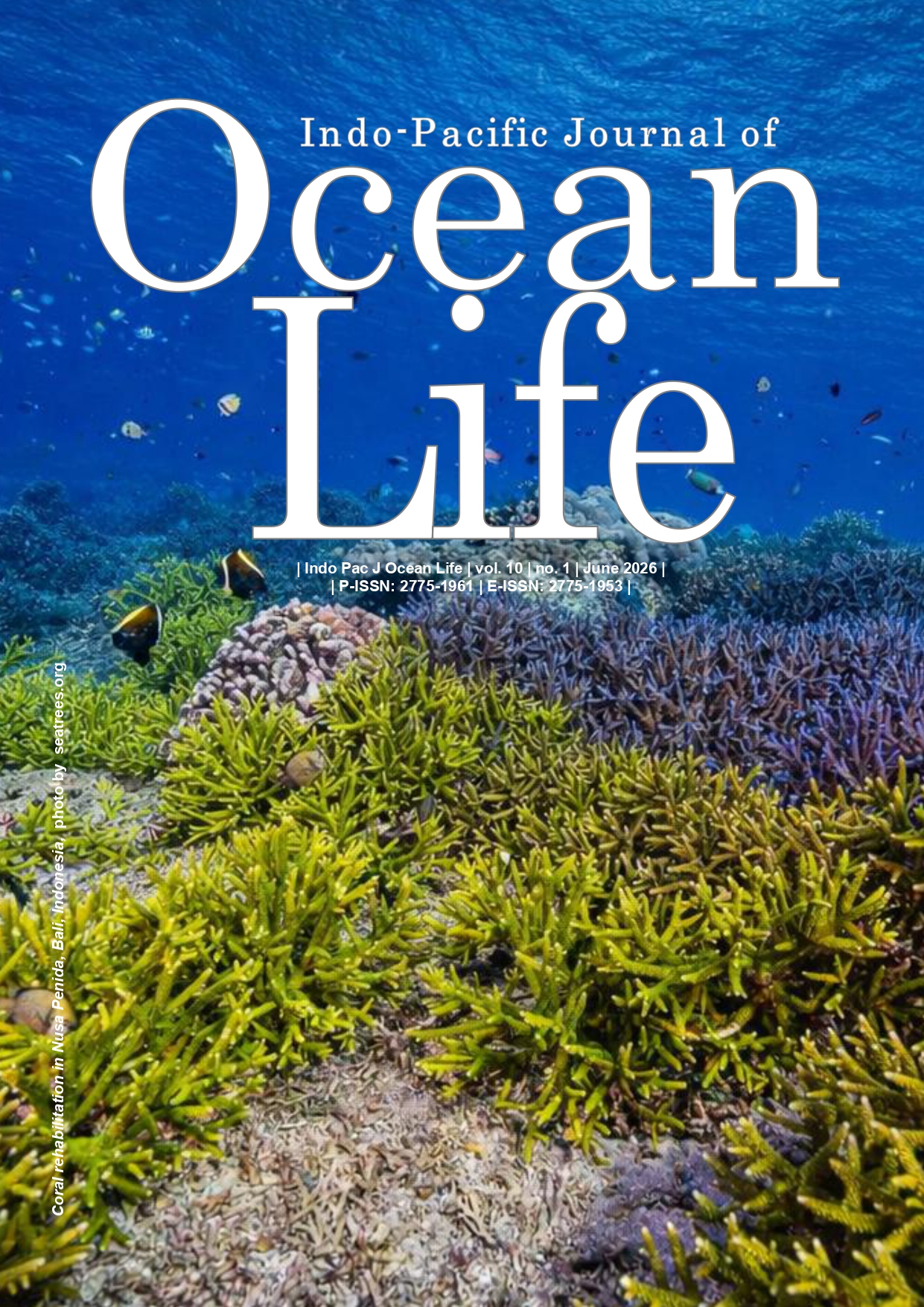
Biological traits of corals under electro-mineral accretion at a coral restoration site in Indonesia
Article Sidebar
Abstract Views: 429
File Views: 204
Main Article Content
Abstract
Abstract. Taylor ACF. 2026. Biological traits of corals under electro-mineral accretion at a coral restoration site in Indonesia. Indo Pac J Ocean Life 10 (1): o100102. https://doi.org/10.13057/oceanlife/o100102. Coral reef restoration efforts risk creating habitats that appear functional yet lack key ecological roles. Electro-Mineral Accretion (EMA)—a method applying low-voltage current to promote calcium carbonate deposition—has been used to enhance coral growth, but its effects on other biological traits remain poorly understood. This study investigated whether corals grown under EMA exhibit trade-offs between growth, reproduction, and skeletal structure compared to natural colonies. At restoration sites in Lombok, Indonesia, colonies of Stylophora pistillata were assessed for fecundity, polyp density, skeletal density, and growth. Growth comparisons of Acropora muricata were also measured between EMA treatments and naturally growing corals. EMA-treated corals showed significantly higher skeletal growth rates but reduced reproductive output, with fecundity 40% lower than natural colonies. Skeleton density was also reduced, suggesting lighter, less robust structures, while differences in polyp density were minor. These patterns indicate that enhanced growth under EMA may occur at the expense of reproduction and structural strength. The findings highlight a key ecological trade-off: faster-growing EMA corals may contribute to short-term reef cover but potentially compromise long-term population viability and resilience. Coral restoration success depends not only on promoting rapid growth but also on preserving reproductive capacity and skeletal integrity. This study underscores the importance of evaluating multiple biological traits when assessing restoration methods and cautions against relying solely on growth enhancement as a measure of ecological success.
Article Details
Issue
Section

This work is licensed under a Creative Commons Attribution-NonCommercial-ShareAlike 4.0 International License.
References
Baums IB, Chamberland VF, Locatelli NS, Conn T. 2022. Maximizing genetic diversity in coral restoration projects. In: van Oppen MJH, Lastra MA (eds). Coral reef Conservation and Restoration in the Omics Age. Springer International Publishing, Cham. https://doi.org/10.1007/978-3-031-07055-6_3.
Boström-Einarsson L, Babcock RC, Bayraktarov E, Ceccarelli D, Cook N, Ferse SC, Hancock B, Harrison P, Hein M, Shaver E, Smith A, Suggett D, Stewart-Sinclair PJ, Vardi T, McLeod IM. 2020. Coral restoration – A systematic review of current methods, successes, failures and future directions. PLoS One 15 (1): e0226631. https://doi.org/10.1371/journal.pone.0226631.
Bracho-Villavicencio C, Matthews-Cascon H, Rossi S. 2023. Artificial reefs around the world: A review of the state of the art and a meta-analysis of its effectiveness for the restoration of marine ecosystems. Environments 10 (7): 121. https://doi.org/10.3390/environments10070121.
Cook N, Cook K, Harris KJ, Songcuan A, Smith AK. 2023. Lessons learned implementing mineral accretion and coral gardening at Agincourt Reef, Great Barrier Reef. Ecol Manag Restor 24 (2-3): 107-118. https://doi.org/10.1111/emr.12585.
Darling ES, Alvarez-Filip L, Oliver TA, McClanahan TR, Côté IM. 2012. Evaluating life-history strategies of reef corals from species traits. Ecol Lett 15 (12): 1378-1386. https://doi.org/10.1111/j.1461-0248.2012.01861.x.
Deng G, Chen X, Kang H, Zhao JX, Wei G. 2024. Millennial calcification trends in Porites corals: Resilient skeletal density and vulnerable linear extension in response to environmental change. Glob Planet Chang 237: 104456. https://doi.org/10.1016/j.gloplacha.2024.104456.
Grinblat M, Eyal-Shaham L, Eyal G, Ben-Zvi O, Harii S, Morita M, Sakai K, Hirose M, Miller DJ, Loya Y. 2023. Energy allocation trade-offs as a function of age in fungiid corals. Front Mar Sci 10: 1113987. https://doi.org/10.3389/fmars.2023.1113987.
Hall VR, Hughes TP. 1996. Reproductive strategies of modular organisms: Comparative studies of reef-building corals. Ecology 77 (3): 950-963. https://doi.org/10.2307/2265510.
Harrison PL. 2024. Sexual reproduction of reef corals and application to coral restoration. In: Wolanski E, Kingsford MJ (eds). Oceanographic Processes of Coral Reefs. CRC Press, Boca Raton. https://doi.org/10.1201/9781003320425-32.
Higgins E, Metaxas A, Scheibling RE. 2022. A systematic review of artificial reefs as platforms for coral reef research and conservation. PLoS One 17 (1): e0261964. https://doi.org/10.1371/journal.pone.0261964.
Hilbertz W, Goreau T. 1996. Method of Enhancing the Growth of Aquatic Organisms and Structures Created Thereby. U.S. Patent No. 5,543,034. U.S. Patent and Trademark Office, Washington DC.
Holcomb M, Cohen AL, McCorkle DC. 2013. An evaluation of staining techniques for marking daily growth in scleractinian corals. J Exp Mar Biol Ecol 440: 126–131. https://doi.org/10.1016/j.jembe.2012.12.003.
Hoogenboom M, Rottier C, Sikorski S, Ferrier-Pagès C. 2015. Among-species variation in the energy budgets of reef-building corals: Scaling from coral polyps to communities. J Exp Biol 218 (24): 3866–3877. https://doi.org/10.1242/jeb.124396.
Knapp ISS, Forsman ZH, Greene A, Johnston EC, Bardin CE, Chan N, Wolke C, Gulko D, Toonen RJ. 2022. Coral micro-fragmentation assays for optimizing active reef restoration efforts. PeerJ 10: e13653. https://doi.org/10.7717/peerj.13653.
Knoester EG, Sanders R, Durden D, Masiga BO, Murk AJ, Osinga R. 2024. Negative effects by mineral accretion technique on the heat resilience, growth and recruitment of corals. PLoS One 19 (12): e0315475. https://doi.org/10.1371/journal.pone.0315475.
Leuzinger S, Willis BL, Anthony KRN. 2012. Energy allocation in a reef coral under varying resource availability. Mar Biol 159 (1): 177-186. https://doi.org/10.1007/s00227-011-1797-1.
Li Y, Zhao H, Zhao Y, Liao X, Chen JY, Qin Y, Lu Z, Zhang Y, He C. 2025. Skeleton-forming responses of reef-building corals under ocean acidification. Research (Washington DC) 8: 0736. https://doi.org/10.34133/research.0736.
Margheritini L, Møldrup P, Jensen RL, Frandsen KM, Antonov YI, Kawamoto K, de Jonge LW, Vaccarella R, Bjørgård TL, Simonsen ME. 2021. Innovative material can mimic coral and boulder reefs properties. Front Mar Sci 8: 652986. https://doi.org/10.3389/fmars.2021.652986.
McLachlan RH, Dobson KL, Schmeltzer ER, Thurber RV, Grottoli AG. 2021. A review of coral bleaching specimen collection, preservation, and laboratory processing methods. PeerJ 9: e11763. https://doi.org/10.7717/peerj.11763.
Meyer D, Schuhmacher H. 1993. Ökologisch verträgliche Bauprozesse im Meerwasser. Geowissenschaften 11: 408–412.
Nugroho BS, Zuhry N, Kusnandar K, Simanjuntak SW, Alamsyah HK, Karissa PT. 2023. Biorock® technology application to the growth and Acropora corals growth rate. IOP Conf Ser Earth Environ Sci 1147 (1): 012003. https://doi.org/10.1088/1755-1315/1147/1/012003.
Perrin N, Sibly RM. 1993. Dynamic models of energy allocation and investment. Ann Rev Ecol Syst 24: 379–410. https://doi.org/10.1146/annurev.es.24.110193.002115.
Quigley KM, Hein M, Suggett DJ. 2022. Translating the 10 golden rules of reforestation for coral reef restoration. Conserv Biol 36 (4): e13890. https://doi.org/10.1111/cobi.13890.
Randall CJ, Negri AP, Quigley KM, Foster T, Ricardo GF, Webster NS, Bay LK, Harrison PL, Babcock RC, Heyward AJ. 2020. Sexual production of corals for reef restoration in the Anthropocene. Mar Ecol Prog Ser 635: 203-232. https://doi.org/10.3354/meps13208.
Rinkevich B, Loya Y. 1989. Reproduction in regenerating colonies of the coral Stylophora pistillata. Environ Qual Ecosyst Stabil 4: 257-265.
Rinkevich B. 1996. Do reproduction and regeneration in damaged corals compete for energy allocation? Mar Ecol Prog Ser 143: 297-302. https://doi.org/10.3354/meps143297.
Roik A, Wall M, Dobelmann M, Nietzer S, Brefeld D, Fiesinger A, Reverter M, Schupp PJ, Jackson M, Rutsch M, Strahl J. 2024. Trade-offs in a reef-building coral after six years of thermal acclimation. Sci Total Environ 949: 174589. https://doi.org/10.1016/j.scitotenv.2024.174589.
Sabater M, Yap H. 2002. Growth and survival of coral transplants with and without electrochemical deposition of CaCO3. J Exp Mar Biol Ecol 272 (1): 131–146. https://doi.org/10.1016/S0022-0981(02)00118-7.
Satria A, Matsuda Y, Sano M. 2006. Questioning community-based coral reef management systems: Case study of Awig-Awig in Gili Indah, Indonesia. Environ Dev Sustain 8 (1): 99-118. https://doi.org/10.1007/s10668-005-0909-9
Schopmeyer S, Galvan V, Hernandez-Delgado EA, Nava G, D’Alessandro M, Carne L, Goergen E, Viehman S, Moulding A, Lirman D. 2024. An evaluation tool for assessing coral restoration efforts. Front Mar Sci 11: 1404336. https://doi.org/10.3389/fmars.2024.1404336.
Tkachenko KS. 2023. Degradation of coral reefs under complex impact of natural and anthropogenic factors with Nha Trang Bay (Vietnam) as an example. Biol Bull Rev 13 (5): 442-459. https://doi.org/10.1134/S2079086423050113.